Final reflections: The push for online learning in higher education (MOOCS) places the inevitability of embracing the internet as a site for learning and creative practice – no matter how deep our resistance. Of the many resistances, the one most vital for me is, in the words of Josephine Dorado, “combining a technology-infused life with a physical, embodied way of being.” And more than that, the urgency of critical pedagogy.
During my Fall 2016 Research Leave I worked with Julie Rothschild ,through her MAPS Anew practice. MAPS Anew operates as a private Facebook page, with the invitation.
a choreography exchange space
a platform for making and sharing
words
videos
photos
sound
participants agree that the work they share is available to the group – to try on, mess up, teach, reconfigure, enjoy
this is a generous space, a respectful space
as the group gets rolling, more will be uncovered about its nature.
There are 21 dancer/choreographer members, about 5 of whom are active on the site at any given time.
Members post videos of short solos. Mostly improvisations. Sometimes edited. Sometimes raw. We comment and reflect on what we see. We have flurries of themed responses to material created.
MAPS Anew gave platform for my current research/artistic practice scholarship, Creative Investigation.
Investigating my aging dancing, my dancing as an aging body, the loss of “those things that came so easily to me” as a younger dancer combined with a shift in what interested me in moving then and now. An investigation both into loss, acceptance, resurgence, something newly possible.
Investigation into uncovering the white-centric positionality of my creative practice.
As I made a commitment to regular choreographic exploration with the group of MAP Anew peers I entered knowing:
- I want/ed to be longer in improvisation before composition.
- I want/ed to be in practice of making with my body on a regular (but open) commitment.
- I need/ed accountability.
I employed iMovie as a tool for editing/creating.
To improvise, to video.
To move to editing: taking out all the movement/moments that were, “meh”
Here is a slideshow sample of Maps Anew:
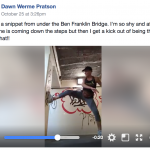
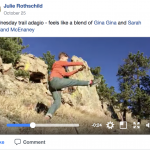
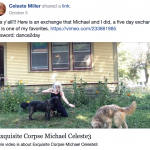
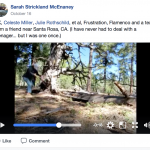
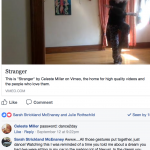
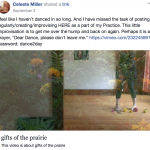
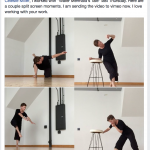
Different than studio practice.
In studio practice I improvise/compose/memorize.
Then edit.
Rearranging, slicing and splicing by physically having to learn/memorize a full phrase. To throw out means to put my body through all the learning/doing all over again.
Here, I use iMovie, I just cut/delete: its gone.
Here, I just cut/replace: sequence changed. Voila.
Play, experiment, cut differently, splice differently.
Try again. Re-cut. Re-edit.
Endless possibilities: My virtual real body.
How is this also about age: because I can’t do it over and over and over again like I used to. (Or….)
This practice: in digital space with others on a different temporal reality opened possibilities.
To post (accountability)
To watch the work of others on one’s own time frame/constrain.
To respond. Because we made a commitment to see, to verbalize/or dance response, to do more than click the little “thumbs up” tab.
To practice finding words when the embodied defies words, but can ask us to reconsider language. Resistant writing.
What was unexpected was that we began to influence each other. We began to pose theoretical questions that begged for embodied response. We created an exchange that could only happen in the digital/virtual environment of this digital/virtual space. But/and with real bodies. Not avatars.
LOCATIONS.
(place)
Working not in the studio.
Opening all spaces as potential sites for dancing.
Like the living room, the laundry room, the coffee shop…
Participants posted dancing in domestic spaces, studio spaces, outdoor spaces, secret spaces (“dancing in a home that is not my own”)
To dance in a studio became less visually exciting than to consider the location in which the video would be shot and how that would fuel the making and the viewing.
Accessibility: Our tribe didn’t need access to studio space to be able to play. And actually, the choice of location began to feed the choreographic thinking.
TEMPORALITY and CELEBRITY
These dance shorts exist only in the private folds of a private Facebook page.
They are so short they defy what is usual for the marketplace of our temporal field.
Every so often, a participant takes one of the developing dances into a more public space. (I’m calling this “celebrity” because for my entire career I have had to place my work “out there”. Out there meant:
- to have the work recognized and seen by audiences (public)
- to have that visibility linked into the professionality of the work: a source for being reviewed, for being funded. For applause.
For me:
Some of the investigation led to the development of my new solo as a piece for non-traditional space, and to a tour of living rooms, taking my solo Once Upon a Time Wolf to domestic spaces in San Francisco, Berkeley and San Diego, and the live streaming of the performance as people watched from their domestic spaces through the window of Facebook). This act challenged CELEBRITY.
As an educator/teaching artist, I wondered: In the teaching of choreography to students at Grinnell, who come to the course with limited exposure to the field of contemporary dance; do these models for dance-making thinking confound the typical pedagogical approach and its tie-in to the US/European-white centric canon of dance-making?
With student assistant Charlotte Richardson-Deppe we used the canvas of my travels during the summer of 2017 as a natural, not devised, canvas for exploring distance-dance communication. Embodiment in virtual digital practices.
Challenge:
What soon unfolded for me as the largest challenge was that my intended collaborators were committed to the idea of Digital Bridges to Dance, but in actuality didn’t make the space in their lives to “play”. The experimentations fell to Charlotte and me often without additional players. In reading Popat’s Invisible Connections: Dance, Choreography and Internet Communties I have used her variables for interacticy to analyse the fuels or hinderances to digital dance-making projects.
Here is what happened/why did/does it work?
Using Popat’s Four Variables for Interactivity:
Frequency of Interaction:
In MAPS Anew there was not a timeline requiring posting within time constraints – but at least one person, if not more, posted something monthly. And then there would often be a flurry or response. Whether that response was a comment in the comment box, a thumbs up, or a danced response.
For DB2D Charlotte and I worked within deadlines and time frames. For instance, Existential Corpse was assigned a five-day window. The live stream events were synchronous – you watched live and created responses in the moment of the live event. The follow-ups were scheduled, thus had a deadline for completion.
“non-precious” or Just Do IT.
Sense of significance: The MAPS Anew community includes people I know and people I have never met. It is satisfying to have these short dances viewed. The significance is in feeling validated by having been viewed by this closed community, not just the generalized Facebook community of friends. TO be viewed/witnessed by others committed to this particular practice.
Immediacy of Response: Within two days, never longer than a week. Someone would have viewed, thumbs-upped, or commented.
Time: We didn’t check calendars for Existential Corpse to find the best time, rather we agreed on the time. The keeping of the exchanges short, and “non-precious” was a factor (Charlotte quote).
As a click culture we are becoming progammed to desire responses. We post, we desire response, we view we click response.
A complaint leveled at various resistors to our current political climate is that we click on a petition, but do we put our bodies on the line.
Range of Options: Because we weren’t trying to end with a choreographic piece with one another, I think this variable translates into how participants chose to respond. Sometimes someone’s post would trigger a flurry of variables. One person posted a request to do a book club around something they were reading. The response by a participant was to translate book club into a choreographic exploration of dancing with books. Several MAPS Anew-ers played with that as a prompt. Several dances made, with our books in our respective homes.
Another kind of response: danced feedback to a posting. Taking similar ideas and exploring the in one’s own body. Or concepts: like inside/outside.
As the group existed over time, we added a request to go beyond the thumbs-up icon but to try and really say something about what we were seeing. This has been a needed exchange to me.
Pedagogical Implications:
I plan to create 1-2 online digital exchange assignments for my Choreography course Spring 2018.
However, it has to be a real, not devised exchange in order for it to be meaningful.
To be continued.
Celeste Miller, August 2017
Dancing Book Club session password: dance2day
Update November 2018
I have joined another online dancing community. Organized by Michael Richter (La Paz, Mexico), twelve dancer/choreographers have agreed to meet online once a month for a year. We have chosen four books that we want to read, in book club model. But rather than talking – for our work, a rotating facilitator will be responsible for designing choreographic/improvisational structures derived from the reading. For a 75-minute session, using the Go To Meeting platform, we meet online and dance together once a month. The books range from fiction to theory.
